Tell us about the job
Takes about a minute. No obligation.
A heat pump running through a long heating season puts its reversing valve, compressor, and defrost controls through repeated cycling under load. Homes in Pulaski County, MO run heat about seven months a year, from October through April. By the time a system shows a fault, the compressor has already been working against falling outdoor temperatures month after month, which is exactly when a heat pump's capacity is most strained. A contractor diagnosing a failure here will check defrost board operation and refrigerant charge before anything else, because those are the parts the heating season grinds on hardest.
Stock built to house older systems and then updated piecemeal is where parts availability becomes the real variable in a heat pump repair. Half the homes in Pulaski County, Missouri were built in 1994 or earlier (2020-2024 ACS 5-year). A contractor who opens the equipment in a house from that era may find components that have passed through more than one adaptation cycle, and sourcing what those components take is not a catalog lookup that ends in minutes. If a part is still manufactured, the repair proceeds. If it is not, the contractor is pricing a workaround or a broader replacement of that circuit, and the scope of the job shifts before the quote does.
The Parts of a Heat Pump a Contractor Checks First
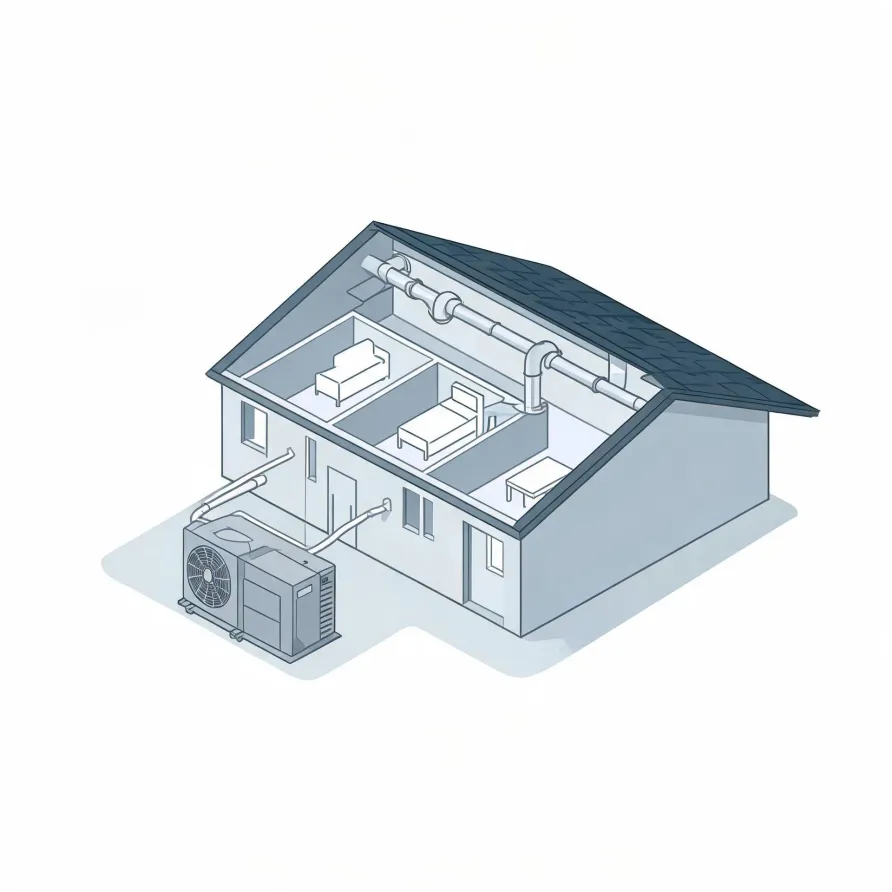
The outdoor unit is the piece most homeowners recognize: a metal cabinet that sits on a pad beside the house, housing the compressor and the outdoor coil. The compressor is where most repair calls begin. When it labors or fails, the system loses its ability to move heat in either direction. The outdoor coil, just inside the cabinet grille, is where a contractor looks when the unit runs but the house stays uncomfortable.
Inside the house, the air handler holds the indoor coil and the blower fan that pushes conditioned air into the living space. A refrigerant line set runs between the two units, and the reversing valve inside the system is what lets a heat pump shift between heating and cooling. When a house gets warm in winter or cold in summer but the unit appears to run, the reversing valve and the expansion device are where a contractor turns next.
The drawing shows a typical layout, and a licensed contractor determines which components apply and what work is needed in your specific home.
Find a contractor in Pulaski CountyPulaski County, by the numbers
115 severe weather events were recorded in Pulaski County, Missouri between 2015 and 2024.
NOAA National Centers for Environmental Information, Storm Events Database, bulk CSV export, events 2015-01-01 through 2024-12-31.Half the homes in Pulaski County, Missouri were built in 1994 or earlier (2020-2024 ACS 5-year).
U.S. Census Bureau, 2020-2024 American Community Survey 5-Year EstimatesPulaski County, Missouri holds 19,431 housing units (2020-2024 ACS 5-year).
U.S. Census Bureau, 2020-2024 American Community Survey 5-Year EstimatesOwners occupy 61.2% of the occupied homes in Pulaski County, Missouri (2020-2024 ACS 5-year).
U.S. Census Bureau, 2020-2024 American Community Survey 5-Year EstimatesSevere Weather Events in Pulaski County
Weather puts a measurable load on heat pumps. The harder a unit has to work to hold indoor temperatures steady, the more wear it accumulates, and that wear is what brings repair calls.
115 severe weather events, 2015–2024. Source: NOAA National Centers for Environmental Information, Storm Events Database.