Tell us about the job
Takes about a minute. No obligation.
A heat pump running in heating mode works its reversing valve, refrigerant circuit, and defrost controls hard, and in St. Louis County it does that through a long stretch of cold months. Homes in St. Louis County, MO run heat about seven months a year, from October through April. Capacity falls as outdoor temperatures drop, so the system cycles more frequently on the coldest days, and that cycling is where the reversing valve wears. A contractor diagnosing a heat pump here checks the reversing valve and refrigerant charge early, because those components carry the bulk of the heating season load and show the damage first.
Much of the housing here was built for heating and cooling systems that no longer exist, and the heat pump now running in it was fitted into whatever that earlier setup left behind. Half the homes in St. Louis County, Missouri were built in 1969 or earlier (2020-2024 ACS 5-year). When a contractor opens a unit, the repair scope can shift depending on what the surrounding infrastructure has become across multiple equipment generations: spliced linesets, modified electrical, ductwork rerouted for a different system. The parts a current heat pump needs are the starting point; what the house has built up around it is where the actual repair lands.
The Parts of a Heat Pump a Contractor Checks First
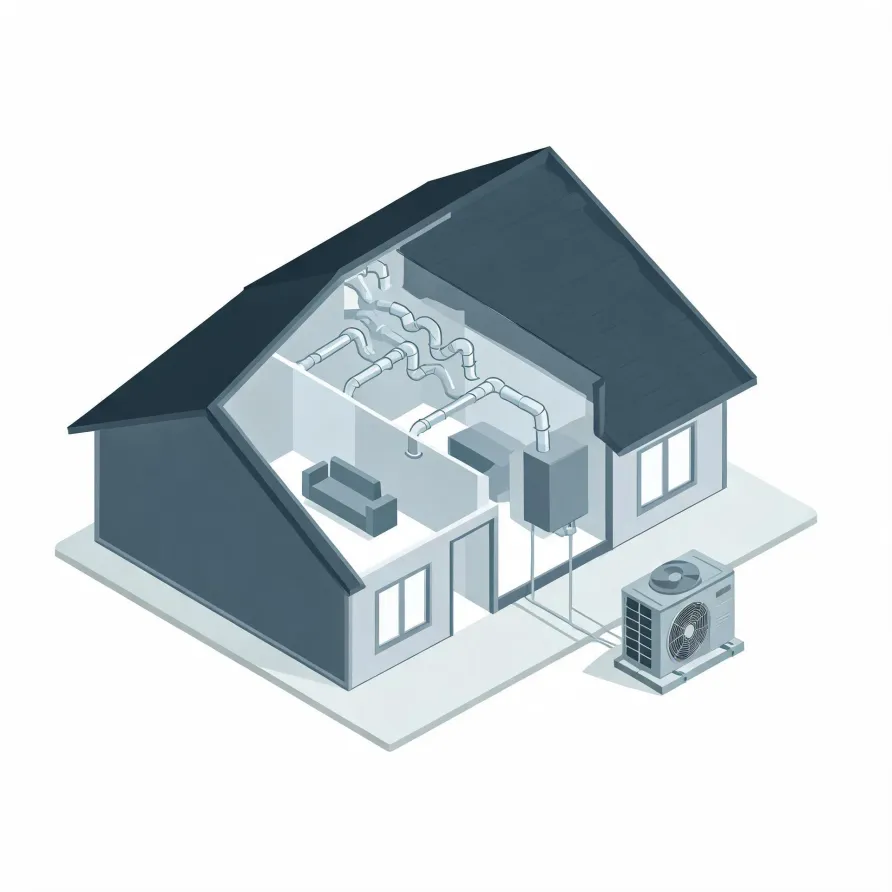
The outdoor unit sits outside the house and holds the compressor and condenser coil. The compressor is where most repair calls begin. When it fails, the system stops moving heat entirely. The condenser coil surrounds the compressor, and a damaged or fouled coil forces the compressor to work harder than it should.
The air handler lives inside the house, usually in a utility closet, basement, or attic, and it holds the evaporator coil and the blower motor. The evaporator coil pulls heat from the indoor air, and a refrigerant leak along it shows up as poor heating or cooling. The blower motor pushes conditioned air through the house, and a failing one often announces itself with noise or uneven airflow. The reversing valve, also inside or at the outdoor unit depending on the model, is what lets a heat pump heat in winter and cool in summer, and a stuck valve is a common reason the system works in one mode but not the other.
The drawing shows the general layout of a heat pump system, and a licensed contractor determines which components apply to your particular house and situation.
Find a contractor in St. Louis CountySt. Louis County, by the numbers
208 severe weather events were recorded in St. Louis County, Missouri between 2015 and 2024.
NOAA National Centers for Environmental Information, Storm Events Database, bulk CSV export, events 2015-01-01 through 2024-12-31.Half the homes in St. Louis County, Missouri were built in 1969 or earlier (2020-2024 ACS 5-year).
U.S. Census Bureau, 2020-2024 American Community Survey 5-Year EstimatesSt. Louis County, Missouri holds 446,192 housing units (2020-2024 ACS 5-year).
U.S. Census Bureau, 2020-2024 American Community Survey 5-Year EstimatesOwners occupy 69.2% of the occupied homes in St. Louis County, Missouri (2020-2024 ACS 5-year).
U.S. Census Bureau, 2020-2024 American Community Survey 5-Year EstimatesSevere Weather Events in St. Louis County, Year by Year
St. Louis County weather puts real strain on heat pump systems, which run year-round and absorb every swing in outdoor conditions. How hard a unit has worked over its life is partly a local question, and storm activity is part of that load.
208 severe weather events, 2015–2024. Source: NOAA National Centers for Environmental Information, Storm Events Database.